
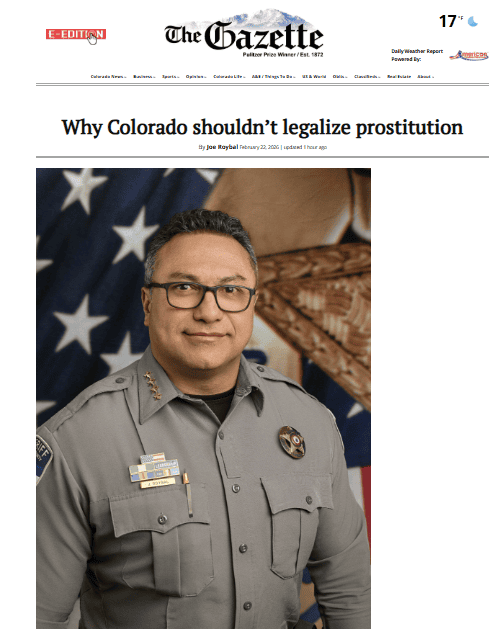
As Sheriff, my foremost responsibilities are to promote public safety, safeguard victims, and hold offenders accountable. Senate Bill 26-097, Decriminalize Adult Commercial Sexual Activity, raises serious concerns across each of these responsibilities.
The bill mandates statewide decriminalization of commercial sexual activity between consenting adults and declares the issue a matter of statewide concern, preempting all local and home-rule laws regulating or prohibiting prostitution-related activity. This action removes the ability of local governments and law enforcement to respond to the distinct public-safety challenges facing their communities.
SB 26-097 repeals multiple criminal offenses, including prostitution, solicitation, patronizing a prostitute, keeping a place of prostitution, public display for prostitution, and key provisions of pandering related to arranging prostitution. Collectively, these repeals would significantly reduce law enforcement’s ability to intervene in situations frequently intertwined with human trafficking, exploitation, organized crime, drug activity, and violence against vulnerable individuals.
Although the bill applies only to “consenting adults,” history shows coercion, fraud, addiction, and economic pressure are often present, making true consent difficult to determine. Removing critical investigative tools risks increasing exploitation while reducing opportunities to identify and assist victims.
For these reasons, SB 26-097 presents substantial risks to public safety, victim protection, and community well-being and warrants heightened scrutiny and careful reconsideration. While supporters argue it will reduce harm, law enforcement experience points to a different, and dangerous outcome: exploitation becomes harder to detect, trafficking easier to conceal, and communities less safe.
Prostitution turns men and women into human commodities, reducing human beings to objects bought and sold. In law enforcement, prostitution rarely appears separate from human trafficking. The two are deeply intertwined. Coercion rarely resembles chains or locked doors; it more often takes the form of addiction, debt, homelessness, prior abuse, or psychological control. Prostitution remains one of the most common pathways into trafficking and is often indistinguishable from it.
Although under SB26-097, penalties remain for overt pimping and intimidation, such cases already rank among the most difficult to prove. Once prostitution is legal, establishing coercion beyond a reasonable doubt becomes even more challenging. Traffickers understand this reality and would adapt quickly, hiding behind claims of “consensual” activity while pressuring victims on what to say.
Under current law, prostitution-related enforcement often provides the first point of contact between victims and law enforcement. These encounters allow officers to identify warning signs, separate individuals from those exerting control, and connect victims with support services. Removing these tools does not improve victim safety; it makes victims less visible.
Equally concerning is the bill’s encroachment upon local government, making prostitution policy a matter of statewide concern, stripping cities and counties of local control. Law enforcement agencies understand communities face different realities. What may appear manageable in one jurisdiction can create significant public-safety and quality-of-life complications in another. Local leaders must retain authority to respond to organized crime, neighborhood impacts, and community concerns.
Experience from other states confirms what many in law enforcement already know: where prostitution is fully decriminalized, demand increases. As demand increases, trafficking and organized criminal activity increase alongside it. Legalization does not simplify policing; it complicates investigations and shields exploiters behind legality.
If lawmakers truly want to reduce harm, better options exist. These include increasing penalties for buyers, traffickers, pimps, and sex offenders; preserving investigative tools; investing in technology used to identify and prosecute offenders; and expanding victim services, treatment, housing, and exit programs. These steps reduce victimization while increasing accountability for criminals.
With more than 30 years of law enforcement experience, concern for the future of Colorado grows daily—for the future our children and grandchildren will inherit. A legislature focused on protecting criminals while limiting law enforcement’s ability to safeguard the most vulnerable moves the state in the wrong direction, both morally and statutorily. Legalizing prostitution fails to support a safe and prosperous future for Colorado and its children.
From the front lines, the reality behind the rhetoric is clear. Legalizing prostitution will not protect the vulnerable; It will shield the criminal market for illicit sex and those who exploit it.
I urge Coloradans to contact their local legislators and insist they oppose SB 26-097, Decriminalize Adult Commercial Sexual Activity. Humans are not for sale in Colorado. This state should reject the bill and pursue policies reinforcing public safety, accountability, and human dignity.
Sheriff Joseph Roybal was sworn into Office in January 2023. He is a Colorado Springs native, the 29th Sheriff of El Paso County, and the first Latino to serve as Sheriff in El Paso County. He began his career in law enforcement in 1995, and is a proud graduate of the 278th session of the FBI National Academy.